

Shared IT infrastructures often lead to unclear cost allocations, manual reconciliations, and a lack of transparency. It is difficult to reliably determine who is actually using which resources using traditional spreadsheets or flat-rate allocations.
TRIN[IT]Y Accounting transforms technical usage data into a transparent billing logic for shared IT infrastructures.
Cross-system, flexibly assignable, and provided in an audit-proof manner—for cost centers, business units, subsidiaries, or external customers.
In complex IT infrastructures, performance, system, and operational data are often presented separately for each system. When applications slow down, administrators must manually compare information from multiple tools to identify correlations and the actual causes.
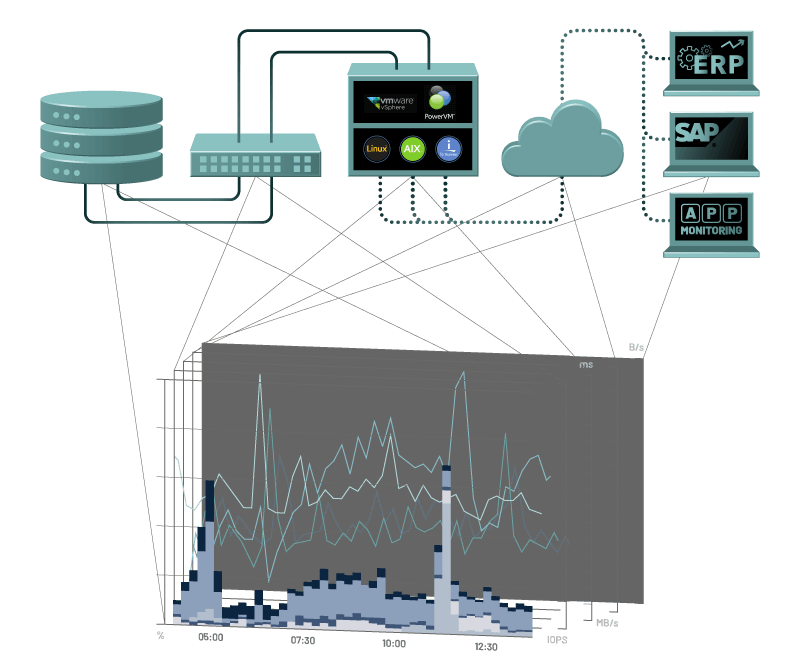
TRIN[IT]Y Performance Monitoring consolidates various data—regardless of system or vendor—into a single view for root cause analysis, supported by predictive alerting; it is specialized for IBM i and agentless.
This makes dependencies, changes, and root causes more quickly apparent—before problems become critical or new hardware is purchased prematurely.
This provides a solid basis for decision-making for operations, IT infrastructure teams, and management.
Flat-rate allocations, Excel spreadsheets, and manual estimates often lead to confusion rather than clarity. It’s often unclear which departments are actually using which infrastructure resources—especially in shared enterprise and IBM Power environments.
TRIN[IT]Y Accounting collects actual usage data across all systems and transparently allocates infrastructure, software, and service costs to the respective cost centers, business units, or customers.
Shared IT infrastructures are rarely compatible with rigid billing models. Different services, platforms, licensing models, surcharges, or project-related costs can quickly lead to complex coordination issues and special cases.
TRIN[IT]Y Accounting enables flexible allocation of infrastructure, software, licensing, and service costs within a single platform. Factors, surcharges, time periods, aggregation rules, and both metered and fixed resources can be flexibly integrated into custom allocation logic.
Different report versions, retroactive changes, and manual reconciliations often complicate the monthly closing process and result in additional reconciliation work between IT, Controlling, and business units.
TRIN[IT]Y Accounting generates audit-compliant settlement reports for specified time periods. Once approved, reports remain traceable and are archived long-term—including audit logs and approval history.
This creates a solid foundation for internal cost allocation, governance and documentation requirements, as well as transparent transfer pricing and monthly closing processes.
In a one-on-one online session, we’ll show you how TRIN[IT]Y works—based on your specific use cases.
Bring your questions and challenges, and we’ll show you live how you can use TRIN[IT]Y to address them and which features are relevant to your IT infrastructure.
TRIN[IT]Y combines up to five metrics from different systems into a single graph—spanning IBM i, SAN, storage, virtualization, and networking.
This makes relationships and interactions immediately apparent—without having to manually consolidate data from multiple systems.
The root cause of a performance issue is often not where the symptoms appear. As a result, troubleshooting in complex IT infrastructures frequently takes up valuable time.
TRIN[IT]Y automatically correlates changes and dependencies across multiple systems. This allows issues to be pinpointed more quickly and resolved more effectively—without having to switch between different tools.
Identify problems before they become critical
Performance issues rarely arise suddenly. Minor deviations, unusual spikes in load, or gradual changes often go unnoticed for a long time—until systems fail or applications become noticeably slower.
TRIN[IT]Y automatically analyzes historical and current performance data, identifies anomalies early on, and supports administrators with intelligent predictive alerts. Unusual trends are automatically detected, and notifications are triggered as soon as defined thresholds are exceeded or not met.
TRIN[IT]Y was specifically developed for complex IBM Power environments and integrates IBM i, AIX, SAN, storage, virtualization, and other IT infrastructure components into a single, unified view.
This includes IBM i-specific features such as wait-time accounting, affinity score monitoring, granular LPAR analysis, and buffer credit zero analysis in the SAN area—features that generic monitoring tools often cannot support.
Additional agents on production systems often result in significant coordination, maintenance, and operational overhead—especially in complex enterprise and IBM Power environments.
TRIN[IT]Y operates entirely without agents, allowing it to be quickly integrated into existing IT infrastructures—without requiring any local agents on the monitored systems.
Queries are performed using dedicated read-only or monitoring users who do not have privileged administrator rights.
In complex SAN and enterprise infrastructures, it quickly becomes difficult to provide a clear overview of actual connections, dependencies, and configuration changes. Fiber Channel environments, in particular, often require a significant amount of manual effort to document fully.
TRIN[IT]Y Performance Monitoring automatically collects configuration and infrastructure information and visualizes Fibre Channel connections end-to-end—from the virtual machine to external storage. As a result, physical and virtual ports, zones, components, connections, and locations are kept up to date and documented in a way that ensures permanent traceability.
In a one-on-one online session, we’ll show you how TRIN[IT]Y works—based on your specific use cases.
Sie bringen Ihre Fragen und Herausforderungen mit, wir zeigen Ihnen live, wie Sie TRIN[IT]Y dafür einsetzen können und welche Funktionen für Ihre IT-Infrastruktur relevant sind.






Any questions?
In a one-on-one online session, we’ll show you how TRIN[IT]Y works—based on your specific use cases.
Or do you already have specific questions? Contact us directly—we’d be happy to help.